Watercolor Sweet Patterns: A Practical Guide to Hand-Drawn Digital Assets
In the realm of digital design, finding a balance between professional polish and organic charm is often the most challenging task. This is where Watercolor Sweet Patterns emerges as a distinct resource for creators looking to infuse their projects with warmth and texture. Unlike rigid vector graphics or mass-produced clipart, this collection offers 15 seamless patterns that capture the delicate unpredictability of hand-painted watercolors. For designers aged 20 to 50 who are evaluating assets for branding, packaging, or web design, understanding the specific utility of these high-resolution files is essential before making a purchase decision.
Understanding the Distinctive Nature of Watercolor Sweet Patterns
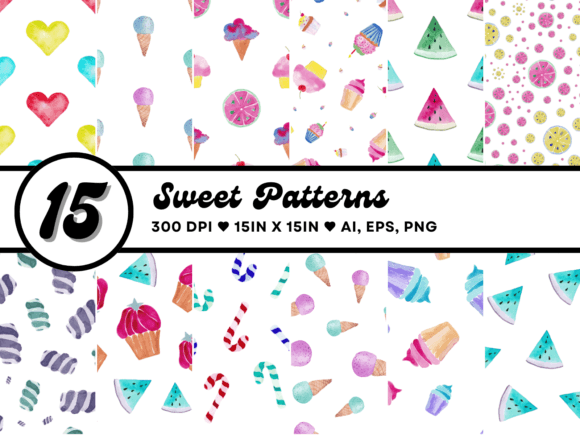
The core appeal of Watercolor Sweet Patterns lies in its ability to replicate the tactile quality of traditional art within a digital workflow. The set features 15 unique seamless designs centered around delightful confectionery themes, including ice creams, watermelons, lollipops, and cupcakes. What sets this collection apart from standard stock illustrations is the inclusion of 50 individual drawings available as PNG files alongside the seamless backgrounds.
This dual-format approach provides significant flexibility. While the seamless patterns allow for infinite tiling on websites or fabric designs, the individual high-resolution elements (up to 16000 x 16000 px) enable designers to deconstruct the imagery. You can isolate a single watermelon slice or a specific cupcake swirl without the distraction of the repeating background. The transparency options included in the package further enhance this versatility, allowing for easy layering over different color schemes without the need for complex masking tools.
The Technical Specifications That Matter
When comparing design assets, resolution and file structure are critical factors that determine usability. Watercolor Sweet Patterns addresses common limitations found in lower-tier digital products by offering substantial dimensions. The primary seamless patterns are provided at 4000 x 4000 pixels, which is sufficient for most standard print and web applications. However, the true standout feature is the availability of large patterns with white backgrounds at 16000 x 16000 pixels.
This massive scale is not merely a marketing metric; it serves a practical purpose for large-format printing. If you intend to use these sweet motifs for packaging, wallpaper, or large-scale signage, the 16000 px dimension ensures that the watercolor edges remain crisp and free from pixelation. Furthermore, the provision of both transparent and white background versions means you do not have to waste time manually removing backgrounds, a process that can often degrade image quality if done incorrectly.
Evaluating Alternatives: Hand-Painted vs. Vector and AI
Designers often face a choice between three main categories of assets: hand-drawn raster art, scalable vector graphics (SVG), and AI-generated imagery. Understanding how Watercolor Sweet Patterns fits into this landscape helps clarify when it is the right tool for the job.
Comparison with Vector Graphics
Vector graphics are renowned for their scalability and clean lines. They are excellent for logos and icons where sharpness is paramount. However, vectors often lack the subtle imperfections that make watercolor appealing. The bleed, the variation in pigment density, and the soft edges of a watercolor wash are difficult to replicate authentically with pure vector paths. If your project requires a "hand-crafted" feel—such as a bakery menu, a children's book illustration, or a boutique brand identity—Watercolor Sweet Patterns offers an authenticity that vectors struggle to match. The tradeoff is that raster images cannot be scaled infinitely without loss of quality, though the 16000 px limit mitigates this concern for most real-world scenarios.
Comparison with AI-Generated Art
Generative AI has flooded the market with sweet-themed imagery. While AI tools are fast and versatile, they often suffer from inconsistencies in lighting, anatomical errors in food items (like melting ice cream that looks unnatural), and a generic "smoothness" that lacks soul. Watercolor Sweet Patterns, being created through human hands, guarantees a consistent artistic voice. The specific style of the brushstrokes remains uniform across all 15 patterns, ensuring that a cohesive visual language is maintained throughout a project. For brands seeking a unique, proprietary look rather than a generic AI aesthetic, this human element is a decisive factor.
Strategic Use Cases and Best-Fit Scenarios
To maximize the value of this asset pack, it is important to align its features with specific project requirements. The combination of seamless tiles and individual elements makes this resource particularly effective in several areas.
- Packaging Design: The high-resolution 16000 px patterns are ideal for wrapping paper, candy boxes, or product labels. The white background version allows for easy integration into existing layout software, while the transparent version facilitates overlay effects on colored packaging.
- Web and UI Design: For blogs, e-commerce sites selling confectionery, or lifestyle brands, the 4000 px seamless patterns serve as perfect hero backgrounds or section dividers. The soft, pastel tones typical of watercolor art create a welcoming atmosphere that encourages user engagement.
- Social Media Content: The 50 individual PNG drawings are perfect for creating Instagram stories, Pinterest pins, or promotional banners. Designers can mix and match the ice cream, lollipop, and cupcake elements to create dynamic collages without worrying about repetitive tile lines.
- Textile and Stationery: The seamless nature of the patterns makes them suitable for fabric printing, scrapbooking, and stationery design. The watercolor texture adds a premium feel that appeals to consumers looking for artisanal products.
Weighing the Tradeoffs and Limitations
While Watercolor Sweet Patterns is a robust resource, it is not a universal solution for every design challenge. It is crucial to evaluate potential limitations before integrating these files into a workflow.
Color Customization Constraints
Unlike vector files where colors can be changed instantly via code or software settings, raster watercolor patterns require manual editing to alter hues. If a brand needs to generate 50 variations of a pattern in different corporate colors, this will require additional time spent in photo editing software. However, the high resolution allows for non-destructive adjustments, meaning you can shift color profiles without introducing artifacts.
File Size and Performance
The inclusion of 16000 px images results in large file sizes. While this ensures print quality, it can impact web performance if not optimized correctly. Designers must be prepared to downscale images for web use or utilize compression techniques to ensure fast loading times. Neglecting this step could lead to sluggish page loads, which negatively impacts user experience and SEO rankings.
Thematic Specificity
The collection is strictly focused on sweets. While this is a strength for relevant industries, it limits applicability for broader design contexts. If a designer needs a general floral or abstract pattern, this specific pack would not suffice. It is a specialized tool designed for a specific mood and subject matter.
Making the Final Decision
Choosing the right design asset comes down to matching the specific needs of the project with the strengths of the available tools. Watercolor Sweet Patterns is an excellent choice for professionals who prioritize texture, authenticity, and high-fidelity reproduction. The inclusion of both seamless backgrounds and isolated elements provides a comprehensive toolkit that covers multiple stages of the design process.
If your goal is to create something that feels warm, inviting, and distinctly handmade, this collection offers a significant advantage over generic stock photos or rigid vector clips. The ability to access individual drawings like ice creams and cupcakes separately allows for creative composition that goes beyond simple tiling. Conversely, if your project demands absolute color flexibility or infinite scaling without any resolution limits, you might consider investing in custom vector work instead.
Ultimately, the decision should be driven by the desired aesthetic outcome. For projects requiring a touch of whimsy and artistic depth, the detailed craftsmanship found in Watercolor Sweet Patterns justifies the investment. By understanding the technical specifications and the unique advantages of hand-drawn watercolor assets, designers can make informed choices that elevate their final output.